

NYFI now covers two more trades out of Asia: the Mediterranean and the US Gulf Coast. Here is what launched, why it matters for benchmarking and index-linked contracts, and how a new NYFI trade gets approved.
Every Friday, shippers, NVOCCs and carriers check NYFI to see where the market moved. Now that coverage is even broader with two new important markets added this week: Asia to Mediterranean and Asia to USGC.
New NYFI Trades
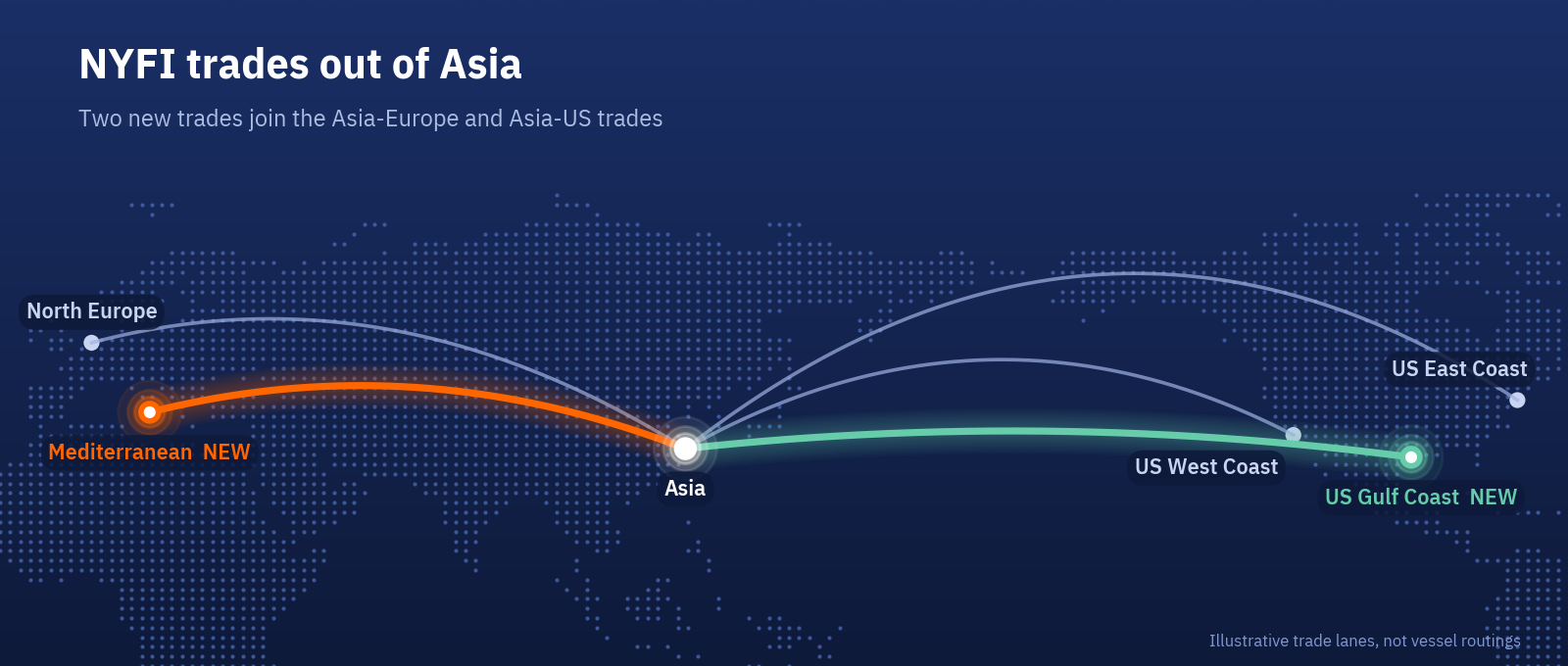
On 26 October 2026, we launched two new trades on the NYSHEX Freight Index (NYFI):
-
- Asia to Mediterranean (ASIA-MED). It sits alongside the existing Asia to North Europe trade, so NYFI now covers both the North Europe and Mediterranean markets.
- Asia to US Gulf Coast (ASIA-Gulf). It complements the existing Asia to US West Coast and Asia to US East Coast trades.
The new indices are available through our platform, APIs and third-party partners. If you don’t have access, sign up here. It only takes 2 minutes.
Details on how NYFI is calculated, including data sourcing and rate composition, are in the NYFI methodology.
Ready for the European Contracting Season
The European contracting season typically starts in September or October, with negotiations running heavily through the end of the year, and final agreements targeting contract start at the beginning of the new calendar year. In other words, the structure of next year’s contracts is being decided now. If you’ve been considering an index-linked contract on a Mediterranean lane, this season could be the time to include that in your tender.
Now, Mediterranean shippers who want an index contract can link it to NYFI and get the benefits of using an index based on actual moving rates in their long-term contracts. Because NYFI reflects the cost of cargo that actually shipped, not quoted rates, it gives index-linked contracts a fundamentally better basis to perform on.
Asia-Europe has already shown why this matters. When the Red Sea crisis began in late 2023, rates moved by multiples within months, and fixed contracts broke for whichever side the market moved against. For this tender season, ASIA-MED gives shippers three things:
-
-
A fact base for evaluating bids. Compare the rates you are offered against what MED cargo actually shipped at, not just against other quotes.
-
An index-linked option. Ask carriers to bid a spread to NYFI ASIA-MED alongside a fixed rate. The negotiation moves from guessing where the market will be to agreeing your position relative to it.
-
Room to rethink contract length. A rate that follows the market can run longer than 12 months, which means fewer tenders and fewer mid-season renegotiations.
-
Our guide to how index-linked contracts work and how to structure one covers the spread, reset schedule, caps and floors in more detail. ASIA-Gulf does the same job for US imports, giving shippers routing cargo through Gulf ports an index for their own coast.
The index-linked contract keeps your cargo moving at a market rate, ensuring you do not get rolled because the market moved against your fixed contract rate, but you of course no longer know that rate in advance. New tools offer a solution. NYFI futures and options are available and traded on ICE, all settled against NYFI, which means budget risk can be managed separately without touching the contract. Futures allow you to lock in a rate for a future month, and a call option allows you to cap what you pay while keeping the benefit if rates fall. When your contract and your hedge follow the same NYFI trade, they move together, so the hedge offsets changes in your freight bill exactly one for one.
How Does a New NYFI Trade Get Approved?
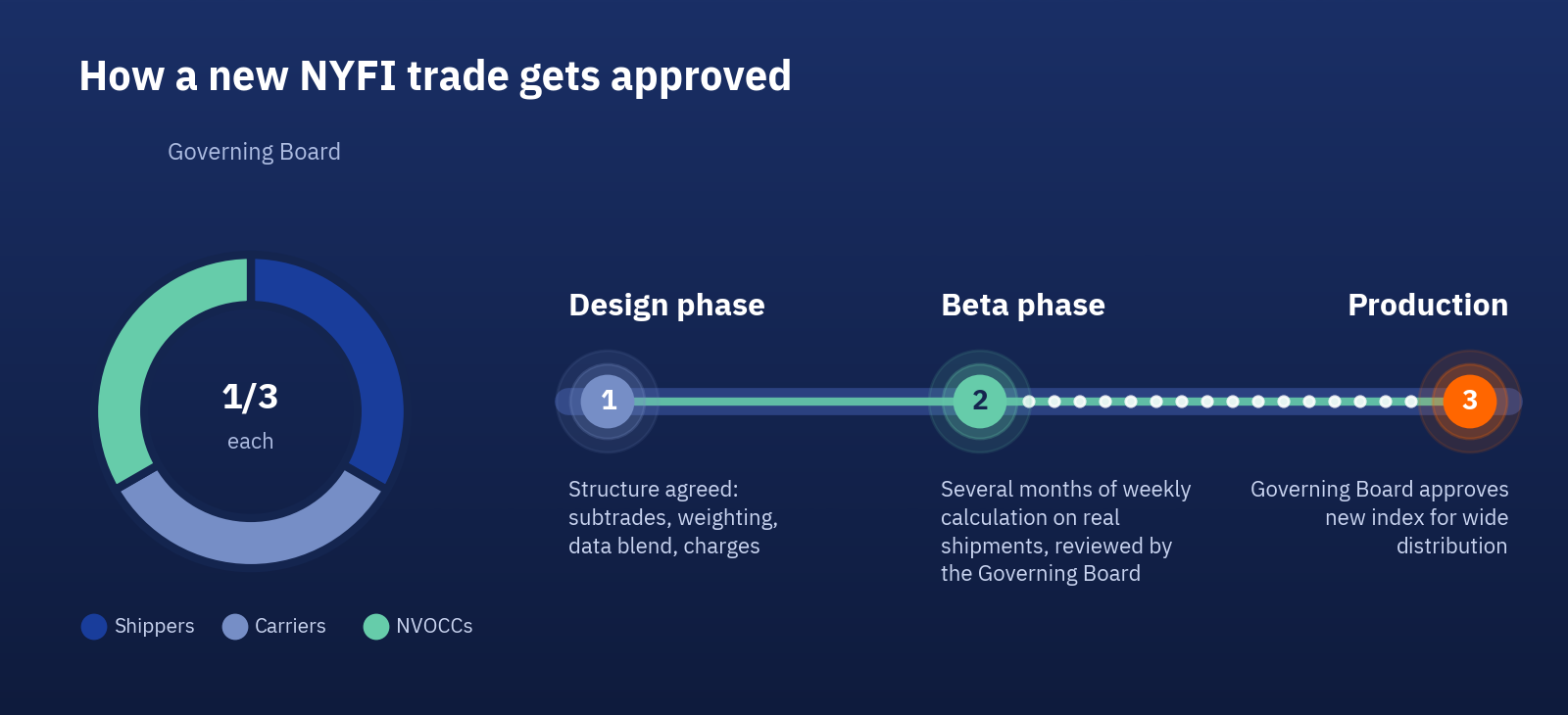
NYFI is governed by an industry-wide board of shippers, carriers and NVOCCs. Each segment holds one-third of the vote, so no single part of the market can influence the index design on its own. NYFI also operates under an agreement on file with the FMC, which allows carriers to sit on the board alongside shippers and NVOCCs and agree on how the indices are developed, changed and audited, under regulatory oversight. The board meets quarterly, and minutes are published after each meeting. Read more about why index governance matters.
Adding a trade follows three steps:
-
- Design. The governing board weighs in on the structure of the index: which subtrades it includes and how they are weighted, how carrier and NVOCC data are blended, which container types are covered, and which charges the rate includes.
- Beta. The board reviews the index in beta for several months, seeing it calculated week after week on real shipments before anyone relies on it in a contract.
- Approval and production. Only then does the board approve the index for production and wide distribution through our channels.
Once live, a new trade follows the same rules as the rest of NYFI: only shipments which have gated-in (FMC trades) or loaded on board (non-FMC trades) in the previous ISO week are included, every data point is validated, and outliers are reviewed under the published NYFI methodology. Both ASIA-MED and ASIA-Gulf went through this process, so they reached production only once the shippers, carriers and NVOCCs who use NYFI agreed they were ready.
Getting started
Sign up or log in to track the new trades for free. NYFI PRO adds subtrade and port-pair indices so you can benchmark your own lane, and if you are in the middle of a tender, you can simulate how an index-linked contract would have performed on your lanes.
NYFI is published weekly, every Friday at 10:00 ET, based on rates for cargo shipped in the previous week.
This article is for general information only and is not investment advice. Trading futures and options involves risk, including the loss of the premium paid.
Want to compare plans first? See what's included in NYFI PRO.
NYFI is published weekly, every Friday at 10:00 ET, based on rates for cargo shipped in the previous week. Lane examples in this article are illustrative.
This article is for general information only and is not investment advice. Trading futures and options involves risk, including the loss of the premium paid.
This article is for general information only and is not investment advice. Trading futures and options involves risk, including the loss of the premium paid.
Want to see how an index-linked contract with a hedge would have performed on your lanes? Simulate your contract with NYFI here.
Want to see how an index-linked contract with a hedge would have performed on your lanes? Simulate your contract with NYFI here.
Want to see how an index-linked contract with a hedge would have performed on your lanes? Simulate your contract with NYFI here.
Want to see how an index-linked contract with a hedge would have performed on your lanes? Simulate your contract with NYFI here.
Want to see how an index-linked contract with a hedge would have performed on your lanes? Simulate your contract with NYFI here.
Want to see how an index-linked contract with a hedge would have performed on your lanes? Simulate your contract with NYFI here.
Want to see how an index-linked contract with a hedge would have performed on your lanes? Simulate your contract with NYFI here.
Why it matters for the container freight derivatives market
Why it matters for the container freight derivatives market
Why it matters for the physical market
Illustrative figures only. They exclude brokerage, clearing fees and margin, and do not reflect actual NYFI levels or option prices.
• A call option protects against rising rates. It pays out if NYFI settles above the agreed level. The natural buyers are those who pay for freight and want protection against rising rates: shippers, BCOs and NVOCCs buying capacity.
• A put option protects against falling rates. It pays out if NYFI settles below the agreed level. The natural buyers are those who sell freight and want protection against falling rates: carriers, and NVOCCs selling at market-linked prices.
Two numbers define every option. The strike price is the NYFI level where protection starts. The premium is what you pay upfront for that protection. A strike close to today's market rate gives more protection and costs more. A strike further away costs less and only pays out on a bigger rate move, much like choosing the deductible on an insurance policy.
Consider an illustrative example of an options hedge. A European importer ships 300 FEU a month from Asia to North Europe on an index-linked contract that moves with NYFI, so its freight bill rises and falls with the market. It has a Q1 freight budget of $3,000 per FEU, or $2.7 million for the quarter. To protect that budget, it buys call options with a $3,000 strike and pays a premium of $150 per FEU. If rates spike and NYFI settles at $4,200, the importer pays $4,200 under its contract, the option pays the $1,200 difference above the strike, and the net cost is $3,150 per FEU: the strike plus the premium. That's $945,000 less than the unhedged bill. If rates soften and NYFI settles at $2,400, the option expires unused, and the importer pays $2,400 plus the $150 premium, a net $2,550 per FEU, well under budget. Either way, the worst case was known on the day the option was bought.
Want to see how an index-linked contract would have performed on your lanes? Simulate your contract with NYFI here.
Want to see how an index-linked contract would have performed on your lanes? Simulate your contract with NYFI here.
Why fixed rates break