
The NYFI Difference: Why Index Governance Matters More Than You Think
Not all freight indices are governed the same way. If you're using an index for benchmarking, contracting, or financial planning, governance matters more than you might think.
Most procurement teams don't spend much time thinking about how a freight index is governed.
If the index appears credible and tracks the market reasonably well, it's easy to assume one benchmark is much like another.
That assumption works when the index is simply providing market context.
It matters much more when the index becomes part of a contract, supports a financial instrument, or helps justify commercial decisions to finance or legal teams.
At that point, governance isn't background information.
It's part of the benchmark's credibility.
Transaction Data Is Only the Beginning
Ocean freight indices are built from one of two data sources: surveys of market participants, or actual executed transactions.
Survey-based indices ask carriers, forwarders, or shippers what they think rates are. The respondents report their perception of market rates, which may or may not reflect what they're actually transacting at. Survey methodology is standard across many financial benchmarks, and there are well-run survey-based freight indices. But surveys have an inherent limitation: a respondent with a commercial interest in a particular rate direction can shade their response accordingly, and there is no executed transaction to verify the reported rate against.
Transaction-based indices measure rates from actual completed bookings. There is no perception involved and no opportunity to shade the input. The rate is what it is because a shipment moved at that price. The dataset is harder to build. It requires real transaction data from market participants, which they have to be willing to provide, but the result is a benchmark that reflects the market as it actually traded, not as participants believe or prefer it to trade.
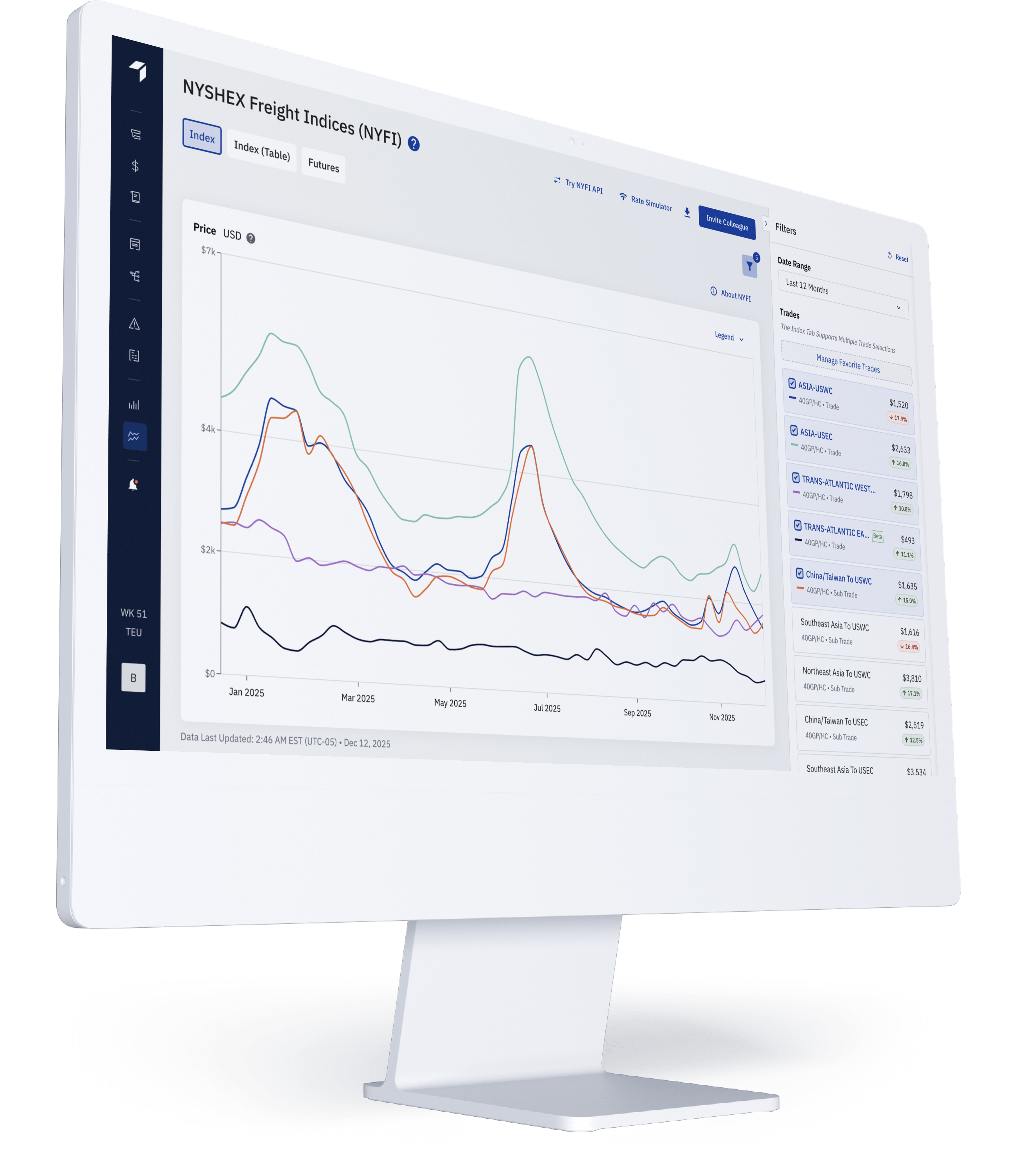
NYFI is built from executed transactions. That's the starting point for everything that follows about why the index is structured the way it is.
The Governing Board Structure
An index built from real transactions still has methodology decisions that can be influenced: which transactions count, how they're weighted, which lanes are included, how outliers are handled. Those decisions shape the output, and the entity making them has leverage over what the index shows.
NYFI addresses this through an independent governing board with representation from all three segments of the market: 3 carriers, 3 NVOCCs, and 3 BCOs or beneficial cargo owners. Each segment holds exactly one-third of the vote, regardless of how many members from that segment attend a given meeting. A carrier bloc that shows up in force cannot outvote the shipper bloc. A shipper bloc that organizes cannot override the carrier and NVO positions. The structure is designed so that moving the index requires consensus across segments with fundamentally different commercial interests.
The board meets quarterly to set methodology and review trade lane coverage. Minutes are published after each meeting. An agreement is on file with the FMC. That level of process and transparency is what allows NYFI to be used in contexts where the integrity of the benchmark is genuinely at stake - a contract that indexes rates to market, a financial instrument that settles against the index, or a regulatory filing that references market rates.
Why This Matters for Procurement
For most procurement applications, the governance structure is background context. You're using the index to benchmark a rate or track a trend, and whether the board met last Thursday doesn't affect your analysis.
It matters most in three specific situations.
The first is contract linking. If your contract includes a clause that ties rate adjustments to a market index, as index-linked contracts are designed to do, the integrity of that index is directly contractually significant. An index that can be moved by a carrier with a commercial interest in higher rates is not a neutral reference in a shipper-carrier contract. An index governed equally by carriers and shippers, with published methodology and FMC oversight, is.
The second is dispute resolution. When a freight cost dispute reaches a point where both sides are citing market rates, the credibility of the reference matters. An index with transparent methodology, published meeting minutes, and an independent governance structure is a defensible citation. A survey-based index from a commercially interested publisher is not.
The third is financial planning. When finance is using a freight index to set budget assumptions, model cost scenarios, or report on market exposure, they are implicitly vouching for the credibility of that index to leadership. An index they can't explain the governance of is a liability in that context. An index with FMC filing and publicly documented methodology is one they can defend.
How NYFI Compares to Other Indices
The SCFI, or Shanghai Containerized Freight Index, is one of the most widely cited indices in global container shipping. It is survey-based, with rates reported by carriers and forwarders. It covers a broad set of trade lanes and updates weekly. For tracking market direction and trends on major lanes, it is useful. While it is widely used for tracking market direction, it was not designed to serve as a governed benchmark for index-linked contracts or financial settlement.
The WCI, or World Container Index published by Drewry, combines NVOCC and freight forwarder-reported data with transaction data and provides a weekly assessment of rates on major trade lanes. It is more analytically rigorous than a pure survey.
NYFI's differentiation is the combination of transaction-only data sourcing and the independent, balanced governance structure. It is the only index in the container freight market with an FMC agreement on file and governing board representation equally distributed across carriers, NVOCCs, and shippers.
What This Leads To
For everyday market tracking, many freight indices can provide a useful view of rate direction.
The distinction becomes much more important when an index moves beyond market commentary and becomes part of a commercial decision.
Whether you're benchmarking rates, structuring index-linked contracts, supporting financial planning, or eventually settling freight futures, confidence in the benchmark depends on confidence in its governance.
That's why governance isn't simply an administrative detail. It's part of what makes a benchmark trustworthy.
< Go back to Ocean Freight Procurement Guide
or Keep Reading From Rates to Signals: How Leading Teams Read the Freight Market >
The market doesn't wait. Your tools shouldn't either.
Ocean freight rates, schedules, and costs change constantly. NYSHEX gives you the visibility and control to stay ahead of what's coming, not explain it after it happens. Choose the plan that fits where you are.