
Oil, power and grain buyers hedge, and container shippers are starting to do the same. But who in a shipper's organisation approves it, how do you access the market, and what does it tie up in working capital? Read a practical guide to taking the first step with container freight futures and options.
Anna and her CFO, Markus, our fictional personas, are convinced. An index-linked contract will take much of the friction out of ACME Home Furnishing's 2027 Europe contract, and a hedge on part of the volume can give Markus a freight budget he can hit and plan around. This setup now enables Anna to focus on her volume plan that will deliver value to ACME and their customers.
However, there is still a practical question lingering about this plan: "Who in my company should be involved, what would it cost, and can we get it approved before we sign the contract?"
Hedging can feel like someone else's job, something for banks and commodity traders. In practice it is a shared job. Procurement knows the volumes and the contract. Finance owns the budget and decides how much risk the company can tolerate. Treasury opens the accounts and manages the cash. At ACME, that is Andy, who leads a small treasury team that has never hedged freight before. In smaller companies, finance often covers treasury too.
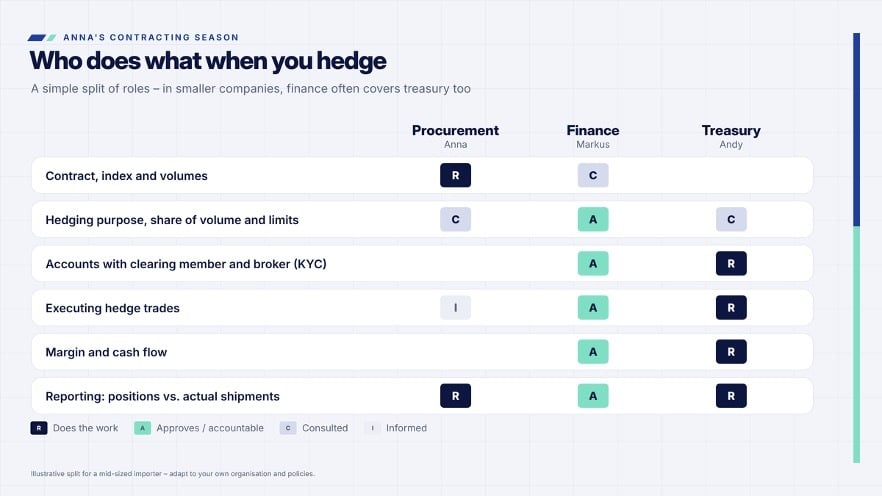
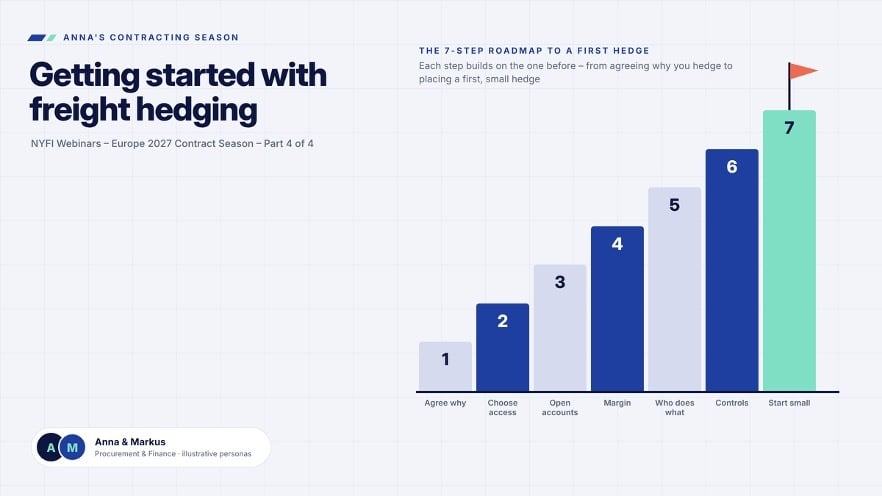
Here is a step-by-step guide to what Anna, Markus and Andy need to do, and why it should start before the contract is signed.
Step 1: Agree why you are hedging
Before any trade, Anna and Markus should agree on the purpose of the hedge. The objective is not to speculate on freight rates. It is to protect a budget on defined volumes with controlled hedging, based on a clear decision about their appetite for market risk. That shapes everything that follows: how much to hedge, for how long and who can trade. Better still, they should take the strategy to their management team for sign-off, so everyone is clear on the position.
Step 2: Choose how to access the market
There are two ways to hedge:
- Over the Counter (OTC). Trade directly with a financial partner, such as a bank. Contracts can be tailored to your needs, but this route may require an existing banking or lending relationship.
- Centrally Cleared (on exchange). Trade standardised contracts such as NYFI futures on ICE Futures Europe, using a broker. The exchange stands between buyer and seller, so there is no counterparty default risk.
Many first-time hedgers start by talking to an intermediary broker. This is an intermediary that matches buyers and sellers and provides prices and market information. It is not the same as the clearing broker described in Step 3, although some firms offer both services.
Step 3: Open the accounts
Once the decision on how to access the market is made, the company needs accounts in place before it can trade. This is the step that takes longest, so start early:
If trading Over the Counter (OTC):
- Relationship with a financial counterparty. This will be a bank or other financial partner.
If trading Centrally Cleared (on exchange):
- A clearing member (sometimes called a “clearing broker”). To access the exchange, an account must be set up with one of the exchange's members. Clearing members provide a range of services to companies trading financial products, and there are many to choose from, so most companies can find a partner that fits their objectives and business type. They will run KYC, AML and other checks on new customers, and the process can take months.
- An intermediary broker. These firms match buyers and sellers and provide market information and real-time pricing for financial contracts. They run similar compliance checks when opening new accounts.
- The index provider. Because the index sets the price of the contracts you trade, it pays to have a direct relationship with the provider of the index your contracts settle on, and a direct source of its data.
If Anna wants a hedge in place when her 2027 contract starts, these accounts need to be opened while she is still negotiating.
Step 4: Know the basics of margin
With accounts in place, Treasury will have to assess how much cash to set aside to support the trading positions. Treasury will be familiar with this; for procurement, the basics are enough.
Exchange-traded futures use two kinds of margin:
- Initial margin. An upfront deposit held as performance security, set based on position size and volatility. It is returned when the position closes or expires.
- Variation margin. The daily cash flow that reflects the change in the position's value. If the market moves against you, you pay; if it moves in your favour, you receive.
Treasury will have to size the cash this needs and plan for it, so it is part of the cost of the hedge alongside fees.
Step 5: Know who does what
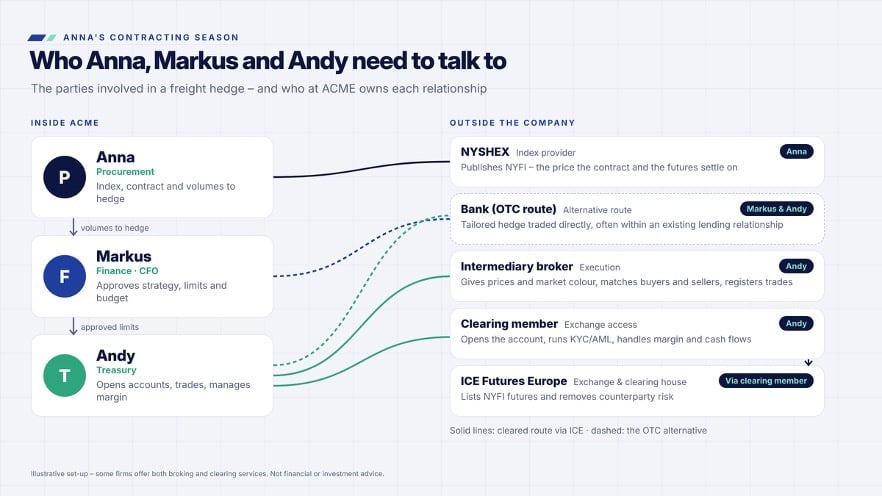
Understanding who does what outside and inside the company across the entire process is important, so controls can be put in place:
Outside the company:
- Index provider (NYSHEX). Publishes the NYFI index, which sets the final settlement price of NYFI futures, and the price an index-linked contract references.
- Exchange and clearing house (ICE). Lists the futures contracts and removes counterparty risk.
- Clearing members and banks. Provide exchange access and handle margin and cash flows; banks can also trade Over the Counter (OTC) directly with clients.
- Intermediary brokers. Match buyers and sellers, register trades, and provide prices and research.
Inside the company:
- Procurement (Anna): Sets the annual freight plan, creates the procurement strategy, negotiates and signs the index-linked contract, and provides the volumes to hedge.
- Finance (Markus): Decides the hedging strategy and limits, and is accountable for the budget.
- Treasury (Andy): Opens the accounts, executes trades within the agreed limits, and manages margin and cash flow.
Step 6: Put simple controls in place
Freight hedging sits alongside Anna's normal contracting and procurement tasks; it doesn't replace them. A short internal policy, in place before the contract is signed, keeps everyone aligned:
- Approval. Who signs off on the risk management strategy (typically the CFO) and who can execute (typically finance or treasury).
- Instruments and brokers. Which contracts and counterparties are approved.
- Limits. Maximum share of volume, how far forward and which trade lanes. Without clear guardrails, hedging can drift from strategy to speculation.
- Reporting. Daily mark-to-market value of positions, and exposure against actual shipments.
- Accounting and legal. How hedges are accounted for, including hedge accounting so the hedge result is recognised in the same period as the freight cost, and how they are documented. Bring your auditors and legal team in early, as rules differ between the EU and the US.
Step 7: Start small
Anna and Markus don't have to hedge everything. Many firms build hedges up over time, executing their volume in separate steps or for different periods at different times. That allows the team to learn and to make sure all procedures work or change their strategy as market conditions change. Financial positions can be increased, reduced, extended or closed at any time as their needs change. Freight futures and options are built to be adjusted.
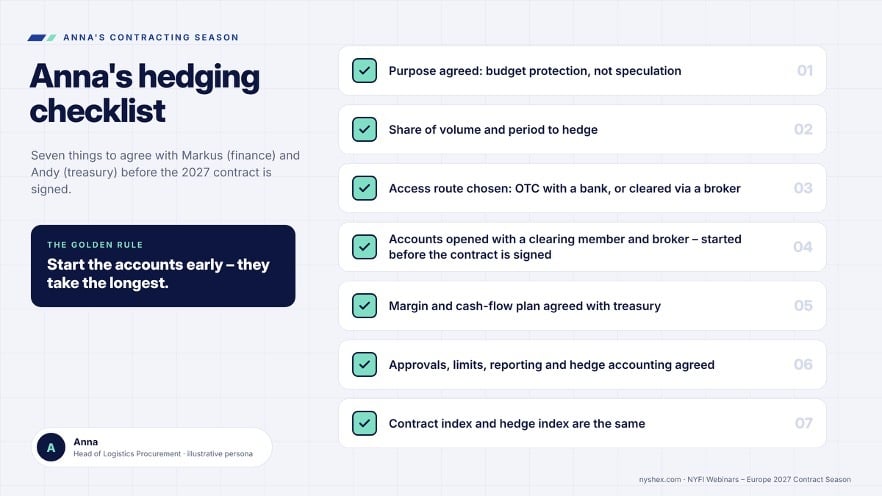
Anna's checklist for the meeting with Markus and Andy
- Purpose agreed: budget protection, not speculation
- Share of volume and period to hedge
- Access route chosen: OTC with a bank, or cleared via a broker
- Accounts opened with a clearing member and broker, started before the contract is signed
- Margin and cash-flow plan agreed with treasury
- Approvals, limits, reporting and hedge accounting agreed
- Contract index and hedge index are the same
How to learn more?
Join our NYFI Webinar: Anna's CFO Call - Hitting a Budget with a Hedge, a step-by-step guide. Live on Thursday 10 December at 09:00 CET (Europe & Asia) and 16:00 CET / 10:00 ET (Europe & US). Rich Heath walks through the worked example live and explains the practical steps to get started with hedging.
Pick your run and register for Webinar 2 here: https://nyshex.com/webinar.
Other blogs in this series:
This blog is part of our series following Anna through the 2027 Europe contracting season, leading up to two live NYFI webinars on 19 November and 10 December. Read more here:
- Part 1 of 4: Preparing for Your 2027 Europe Tender: Five Questions to Ask Before You Set Up an Index-Linked Contract
- Part 2 of 4: A Rate That Follows the Market: How to Set Up an Index-Linked Contract for Your 2027 Europe Tender
- Part 3 of 4: What Happens to Your Freight Budget if the Market Doubles? Futures and Options in Plain Words
Anna and ACME Home Furnishing GmbH are an illustrative composite, not a real customer. All prices and figures in examples are illustrative. This article is for educational purposes only and does not constitute financial, investment, legal or trading advice.
Want to compare plans first? See what's included in NYFI PRO.
NYFI is published weekly, every Friday at 10:00 ET, based on rates for cargo shipped in the previous week. Lane examples in this article are illustrative.
This article is for general information only and is not investment advice. Trading futures and options involves risk, including the loss of the premium paid.
This article is for general information only and is not investment advice. Trading futures and options involves risk, including the loss of the premium paid.
Want to see how an index-linked contract with a hedge would have performed on your lanes? Simulate your contract with NYFI here.
Want to see how an index-linked contract with a hedge would have performed on your lanes? Simulate your contract with NYFI here.
Want to see how an index-linked contract with a hedge would have performed on your lanes? Simulate your contract with NYFI here.
Want to see how an index-linked contract with a hedge would have performed on your lanes? Simulate your contract with NYFI here.
Want to see how an index-linked contract with a hedge would have performed on your lanes? Simulate your contract with NYFI here.
Want to see how an index-linked contract with a hedge would have performed on your lanes? Simulate your contract with NYFI here.
Want to see how an index-linked contract with a hedge would have performed on your lanes? Simulate your contract with NYFI here.
Why it matters for the container freight derivatives market
Why it matters for the container freight derivatives market
Why it matters for the physical market
Illustrative figures only. They exclude brokerage, clearing fees and margin, and do not reflect actual NYFI levels or option prices.
• A call option protects against rising rates. It pays out if NYFI settles above the agreed level. The natural buyers are those who pay for freight and want protection against rising rates: shippers, BCOs and NVOCCs buying capacity.
• A put option protects against falling rates. It pays out if NYFI settles below the agreed level. The natural buyers are those who sell freight and want protection against falling rates: carriers, and NVOCCs selling at market-linked prices.
Two numbers define every option. The strike price is the NYFI level where protection starts. The premium is what you pay upfront for that protection. A strike close to today's market rate gives more protection and costs more. A strike further away costs less and only pays out on a bigger rate move, much like choosing the deductible on an insurance policy.
Consider an illustrative example of an options hedge. A European importer ships 300 FEU a month from Asia to North Europe on an index-linked contract that moves with NYFI, so its freight bill rises and falls with the market. It has a Q1 freight budget of $3,000 per FEU, or $2.7 million for the quarter. To protect that budget, it buys call options with a $3,000 strike and pays a premium of $150 per FEU. If rates spike and NYFI settles at $4,200, the importer pays $4,200 under its contract, the option pays the $1,200 difference above the strike, and the net cost is $3,150 per FEU: the strike plus the premium. That's $945,000 less than the unhedged bill. If rates soften and NYFI settles at $2,400, the option expires unused, and the importer pays $2,400 plus the $150 premium, a net $2,550 per FEU, well under budget. Either way, the worst case was known on the day the option was bought.
Want to see how an index-linked contract would have performed on your lanes? Simulate your contract with NYFI here.
Want to see how an index-linked contract would have performed on your lanes? Simulate your contract with NYFI here.
Why fixed rates break