

Fixed annual rate contracts break whenever the market moves far enough, and they break for whichever side the market has moved against. Index-linked contracts are designed to fix that. Here's a plain-language guide to how they work, the decisions that go into structuring one, and why the NYFI freight index is best suited to index against.
For most of its history, container shipping has priced itself as if there were no market price. Once a year, shippers and carriers agree a rate per container and a teu commitment, sign for 12 months, and hope the market stays roughly where they left it.
The last six years have shown how rarely it does. The pandemic, the Red Sea crisis and this year's Hormuz disruption each moved rates by multiples within months, each for a different reason. Even carriers can't see it coming.
Index-linked contracts are the industry's answer to a price that can't be forecast. This guide explains how they work, what you need to decide when you structure one, and why the index you choose matters as much as the contract itself.
Why fixed rates break
A fixed annual rate contract looks like certainty. In practice, it carries a hidden option to walk away, and that option belongs to whichever side the market has moved against:
- When spot rates run far above contract, capacity migrates to spot. Contract cargo gets rolled, surcharged or renegotiated, and the shipper with the cheapest rate becomes the one left on the quay.
- When spot rates fall far below contract, the incentive flips. Shippers push for mid-season cuts or quietly move volume to spot.
Either way, the contract fails for the party who’s out of the money, and it fails at the point in time when it was supposed to provide stability.
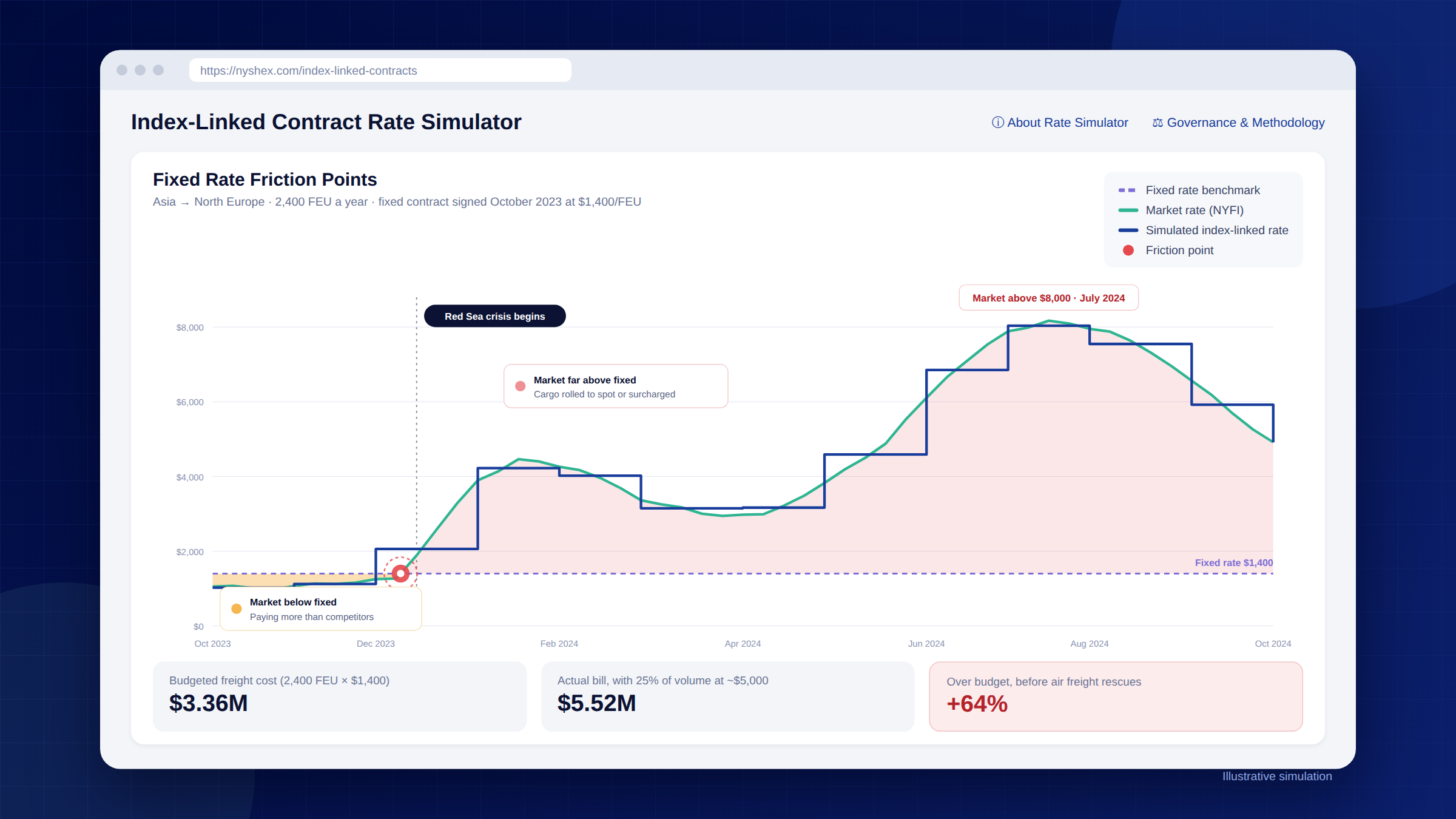
Consider an illustrative European importer shipping 2,400 FEU a year from Asia to North Europe. In October 2023, with the market near an all-time low of about $1,000 per FEU, it signs a fixed contract at $1,400 and budgets $3.36 million. Six weeks later the Red Sea crisis begins, and by July 2024 the same lane prices above $8,000. If a quarter of the year's volume ends up rolled onto spot or surcharged at an average of $5,000 per container, the freight bill lands at $5.52 million, 64% over budget, before counting air freight rescues etc. The best rate on paper produced the worst position in practice.
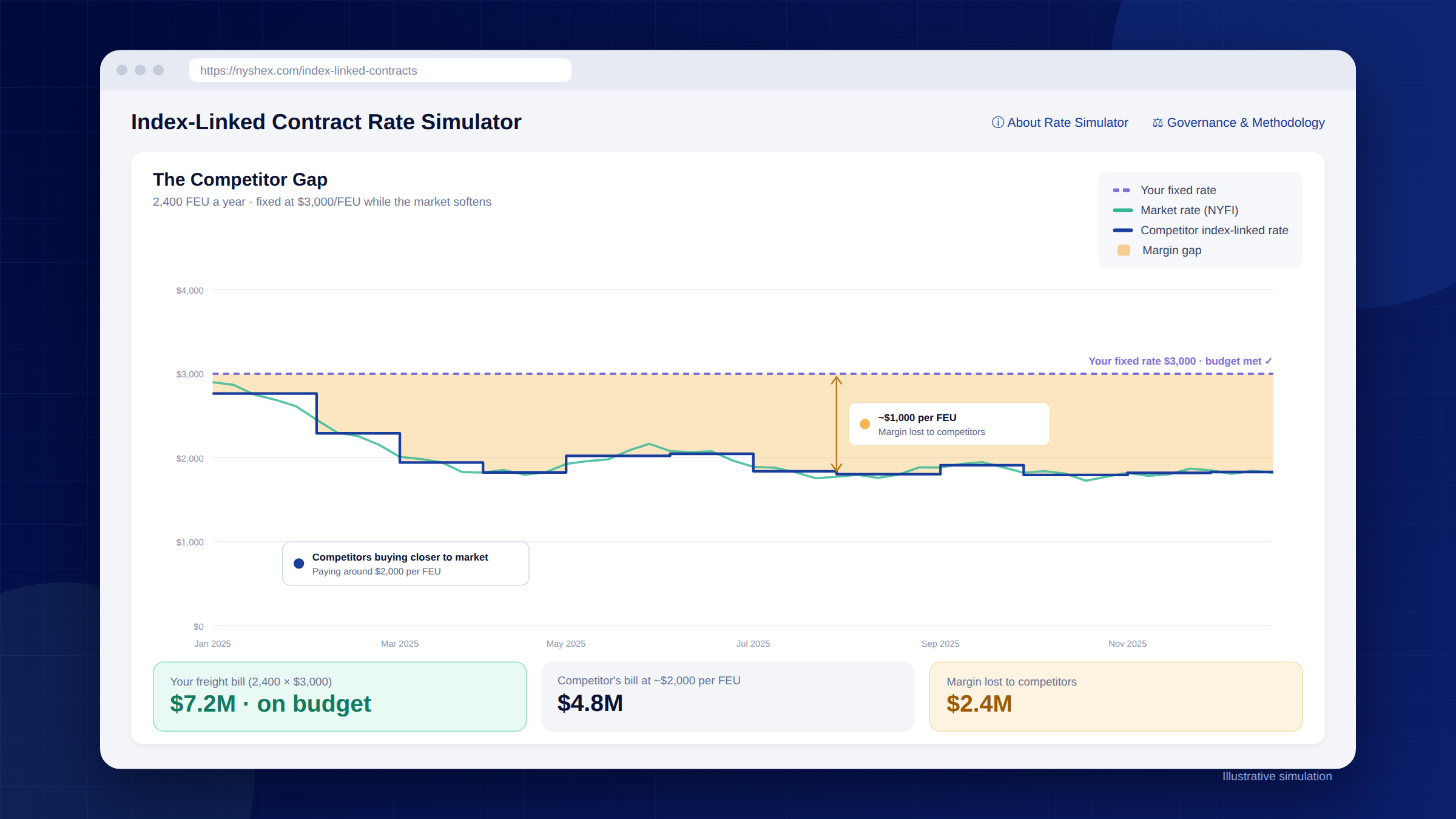
There's also a quieter risk that fixed rates create: paying more than your competitors. Lock in $3,000 per FEU while competitors buying closer to market pay $2,000, and you can hit your budget while still losing margin.
How an index-linked contract works
An index-linked contract keeps everything that makes a contract valuable (allocation, service levels and volume commitments) but lets the rate move with a published freight index. Instead of agreeing a number for 12 months, shipper and carrier agree a formula, typically the index plus or minus a fixed spread, and a drift trigger or schedule for resetting the rate against it.
Because the contract rate never drifts far from the market rate, neither side has a reason to defect. The carrier has no incentive to roll your cargo when the market spikes, and you have no incentive to walk when it falls. The contract does what it's actually good at, securing space, and the price simply follows the market.
A useful comparison is how many manufacturers buy electricity. They pay the market price for power, on a published benchmark, and treat the price volatility risk that comes with an index-linked contract as a separate decision. Ocean freight can now work the same way.
This is no longer a niche idea. Large shippers have moved from the traditional 90/10 contract-to-spot split toward 80/20 or 75/25, and a growing share of the contracted portion is now indexed rather than fixed. Several of the largest carriers report double-digit percentages of their contract books linked to indices.
Five decisions that shape an index-linked contract
Index-linked contracts are simple in principle, but the details decide how well they work. These are the five decisions worth getting right.
- The index and lane. Choose a benchmark that covers the specific trade and equipment type you ship, not a global composite. More on choosing the index below.
- The spread. The rate is usually expressed as the index plus or minus a fixed amount per container (for example NYFI − $150/FEU). This is where the negotiation moves: instead of arguing over where the market will be next year, you negotiate your position relative to the market. Your volume, consistency and service requirements still earn you a better spread.
- The reset schedule. Rates typically reset weekly or monthly, often against the average of the index over the previous period. More frequent resets keep the contract closer to market; less frequent ones make invoicing and budgeting simpler.
- Caps, floors and bands. It's tempting to add a ceiling to protect against a spike, and carriers often agree to one. But freight rates have a soft floor near carriers' operating costs and no real ceiling, so a cap is far more valuable than the floor usually traded for it. If you include one, expect it to be priced into the spread, applied to committed volume only and reviewed regularly. An uncapped, floating rate is what removes the incentive to defect on both sides.
- Volume and service commitments. The contract still needs to say how much you'll ship and what the carrier will provide. That's the part that keeps your cargo on the ship.
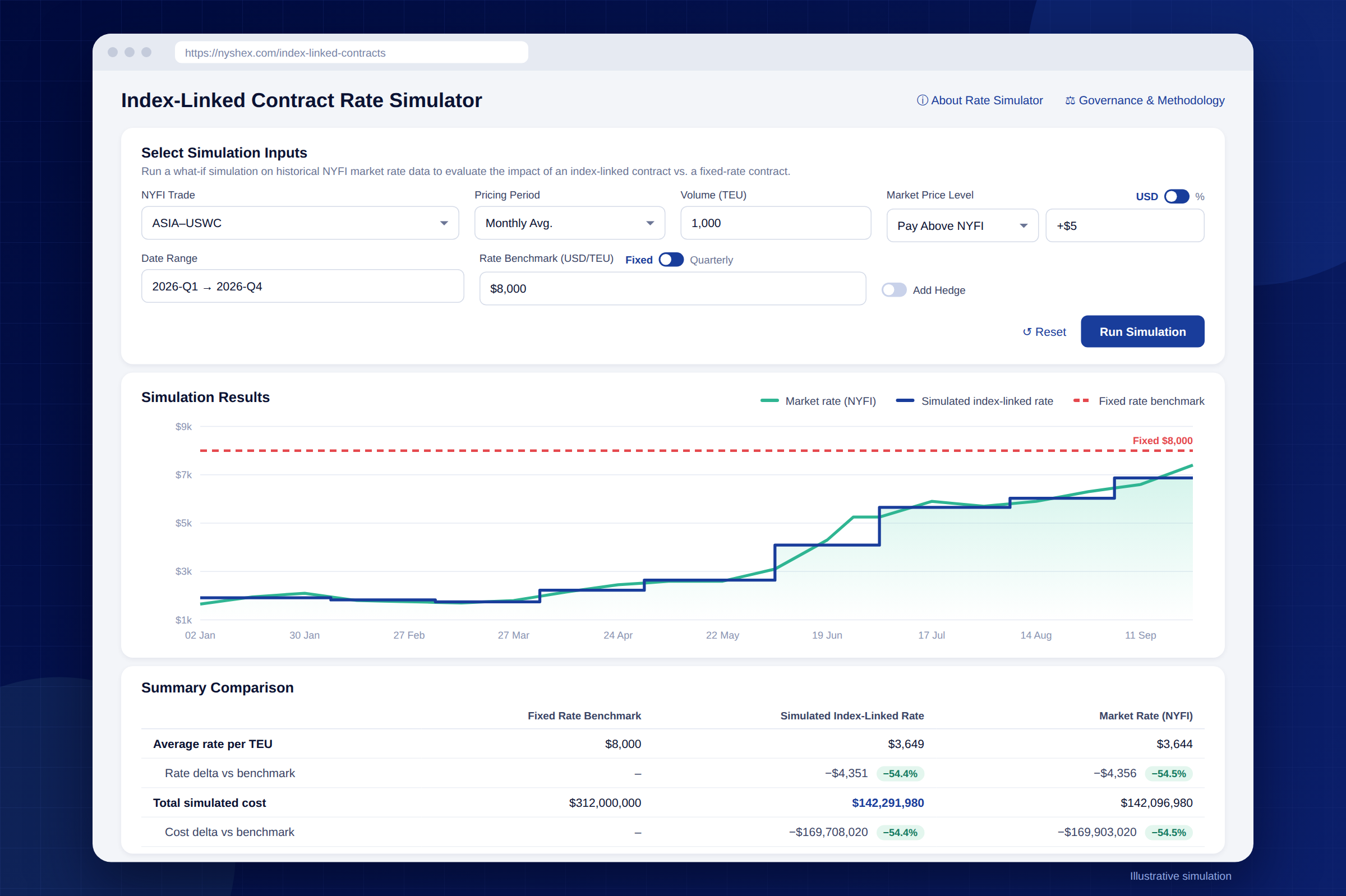
Because the rate no longer depends on calling the market correctly, many index-linked contracts also run longer than the traditional 12 months, which means fewer tenders and fewer mid-season renegotiations. Want to see how an Index-Linked Contract would have performed on your trades, use the NYSHEX Rate Simulator for free.
Want to see how an index-linked contract would have performed on your lanes? Simulate your contract with NYFI here.
The trade-off: your rate will move
An index-linked contract doesn't make freight cheaper in every scenario. In the Red Sea example above, an index-linked rate would have risen with the market, and on paper it would have cost more than the $1,400 fixed rate. The difference is that the cargo would have moved, on schedule, at a cost that was visible and governed rather than improvised through rollings and surcharges. And when the market fell back in 2025, the rate would have fallen with it.
What changes is where the uncertainty sits. Your freight cost now follows a published, transparent benchmark rather than a fixed number that holds only until the market moves. However, this poses a challenge for freight budgets, since you don’t know what you will actually pay. This is a function of the future market rate. The price risk can be managed separately with container freight futures settled against the same index, without touching the contract itself.
Choosing the index
An index-linked contract is only as good as the index behind it. Freight Indices differ in what they measure, whose prices they are based on and who oversees them. When you choose an index for a contract, five questions are important:
- Shipped or quoted? Quotes and booking-stage prices show direction. Rates for cargo that actually sailed show the price the market cleared at, which is what your contract should track.
- Whose prices? An index built from one side of the market, or one sales channel, can sit systematically high or low. A balanced panel gets closer to a true mid-market rate.
- Who governs it? Both parties have to trust the number. Look for published methodology, independent oversight and a board where shippers and carriers both have a seat.
- Lane-level or composite? The index should cover your actual trade and equipment type.
- Can it be hedged? If you may ever want to fix your cost with futures, an index that also settles futures avoids basis risk, the gap between two different benchmarks.
NYFI was built to support all 5 questions: rates for shipped cargo only, a balanced panel of carriers and NVOCCs, equal governance between shippers, carriers and NVOCCs under an FMC agreement, free access, and futures on ICE settled against the same index. Read more on why index governance matters.
Getting started
You don't need to move your whole portfolio at once. Most shippers start with one or two high-volume, recurring lanes where rate swings have caused the most friction, run one contract cycle, and expand from there. For help deciding which lanes suit index-linked, fixed or spot contracts, see our guide to structuring your tender, or reach out to us.
Want to see how an index-linked contract would have performed on your lanes? Simulate your contract with NYFI here.
Want to see how an index-linked contract would have performed on your lanes? Simulate your contract with NYFI here.
Why fixed rates break