
Ocean Freight Surcharges: Complete List and What Each One Means
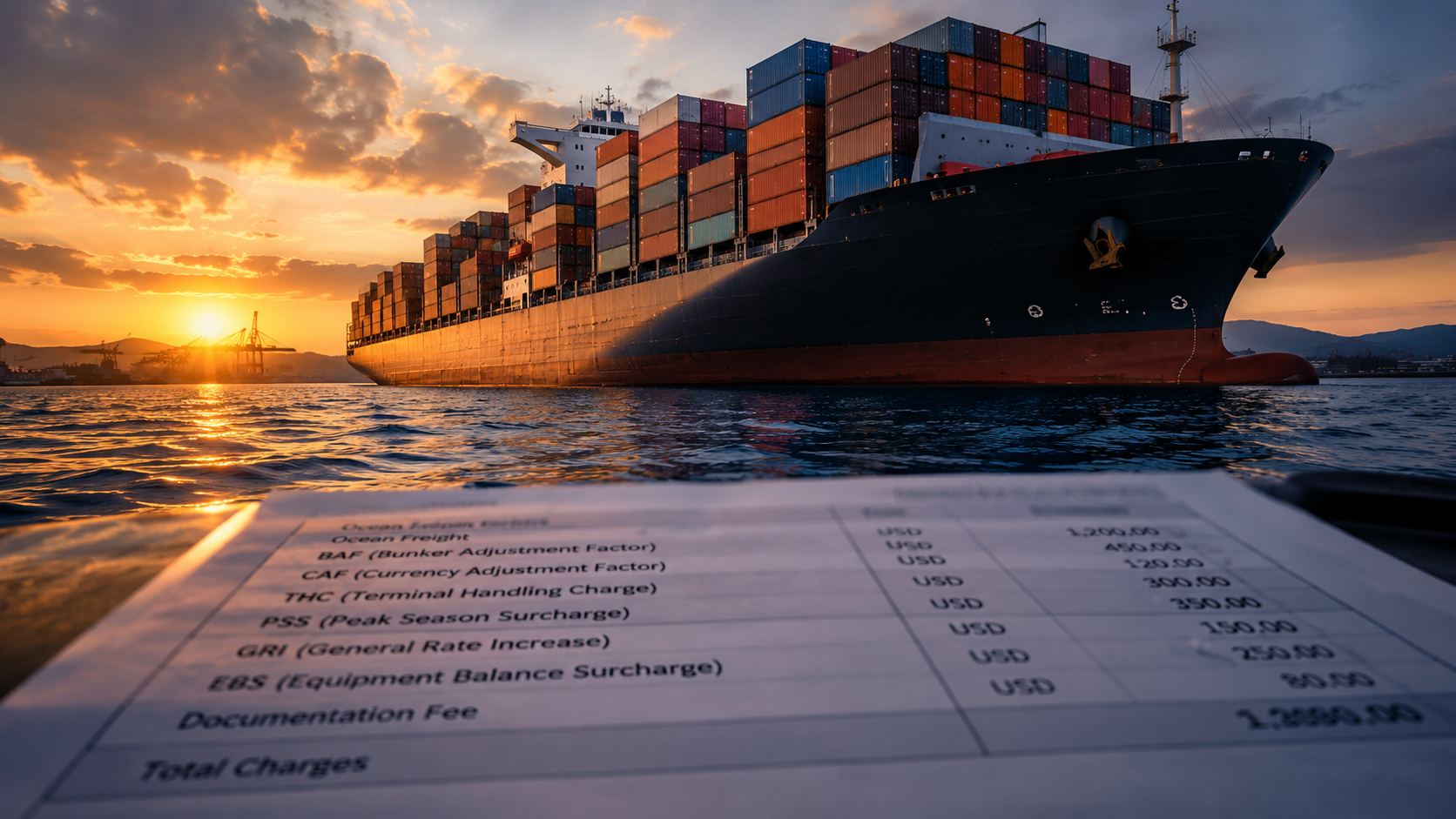
This guide covers every major ocean freight surcharge, organized by category, with plain-language definitions and the abbreviations you will see on freight quotes and invoices.
What Is an Ocean Freight Surcharge?
An ocean freight surcharge is an additional fee charged by an ocean carrier on top of the base freight rate. Surcharges exist because carriers face variable costs that change faster than base rates can be renegotiated. Rather than repricing every lane every week, carriers isolate volatile cost components and pass them through as separate line items.
Surcharges are standard across all carriers and trade lanes, though the specific names, abbreviations, and amounts vary by carrier, route, and market conditions.
Base Rate vs. All-In Rate: How Ocean Freight Pricing Is Structured
The base rate (also called the base ocean freight rate or sea freight rate) covers the port-to-port transportation of a container. It does not include terminal handling, fuel adjustments, seasonal premiums, or regulatory compliance costs.
An all-in rate bundles the base rate together with most or all surcharges into a single quoted figure. All-in rates offer price certainty but can obscure which cost components are driving the total. When benchmarking quotes across carriers, understanding the underlying surcharge structure is the only reliable way to make apples-to-apples comparisons.
A third structure sits between these two: a fixed base rate with floating surcharges. This is common in annual service contracts where the base ocean freight rate is locked for the contract term, but fuel surcharges (BAF, LSS), peak season surcharges, and emergency surcharges remain variable and adjust throughout the year based on market conditions or carrier-published schedules. This structure is often misread as a fixed-cost commitment when it is not. The base rate is fixed; the total cost is not. Shippers operating under this model can see significant invoice variance over a 12-month contract even when the base rate never changes.
The gap between a quoted base rate and a final invoice is almost always explained by surcharges. Knowing each one prevents invoice surprises and strengthens your position in rate negotiations.
Fuel Surcharges
Fuel is the largest variable operating cost in ocean shipping. Carriers use several fuel-related surcharges to pass through fluctuations in bunker prices, fuel grades, and regulatory compliance costs.
BAF -- Bunker Adjustment Factor A variable surcharge applied to compensate carriers for changes in marine fuel (bunker) costs. BAF adjusts periodically based on published bunker price indices for a given trade lane. It is one of the most common surcharges on any freight invoice and typically represents 15 to 25 percent of the base rate.
EBS -- Emergency Bunker Surcharge A temporary surcharge applied when crude oil or bunker prices spike rapidly and the carrier cannot adjust base rates or BAF quickly enough to cover the increase. EBS is typically short-term and route-specific.
LSS -- Low Sulfur Surcharge (also LSF: Low Sulfur Fuel Surcharge) Introduced following the IMO 2020 sulfur cap regulation, which required vessels to switch from high-sulfur fuel oil to more expensive low-sulfur alternatives. LSS covers the premium cost of compliant fuel. Depending on the carrier, it may appear as a standalone line item or be rolled into BAF.
FAF -- Fuel Adjustment Factor A fuel surcharge used primarily on Japan trade routes. Functionally similar to BAF but specific to certain carrier and route combinations.
ECS -- Environmental Compliance Surcharge Applied by carriers to recover costs associated with broader emissions compliance, including IMO CII (Carbon Intensity Indicator) ratings requirements and investment in cleaner propulsion technology. Increasingly common as decarbonization regulations tighten.
Rate Adjustment Surcharges
GRI -- General Rate Increase A blanket rate increase applied by carriers across a trade lane, typically announced several weeks in advance. GRI is used to restore base rate levels when market pricing has eroded. It is one of the most negotiable surcharges for shippers with volume leverage.
CAF -- Currency Adjustment Factor Compensates carriers for fluctuations in exchange rates between the currency in which freight is quoted (usually USD) and the currencies of the countries where the carrier incurs costs. CAF is more commonly itemized on European and West African trade lanes, though it exists across all routes.
Terminal and Port Surcharges
THC -- Terminal Handling Charge A fee for the physical handling of containers at the port terminal, covering lifting, shifting, and stacking operations. THC is charged at both origin and destination and is usually set by the terminal operator, not the carrier.
OTHC -- Origin Terminal Handling Charge THC applied at the port of loading.
DTHC -- Destination Terminal Handling Charge THC applied at the port of discharge.
ORC -- Origin Receiving Charge (also LRC: Local Receiving Charge) A handling charge specific to ports in South China, primarily in Guangdong province. ORC and THC are mutually exclusive on those routes -- only one is charged. ORC applies to shipments departing South China ports for North America, Central and South America, Europe, and North Africa.
DDC -- Destination Delivery Charge A fee applied at the destination port covering container handling and delivery order processing. Common on US and Canada trade lanes.
PCS -- Port Congestion Surcharge Applied when a port experiences significant congestion that extends vessel waiting times, increases berth fees, and raises overall port costs. PCS is route- and time-specific and can appear with little advance notice during periods of high port activity.
WHF -- Wharfage Fee A charge for using the port's wharf infrastructure. Applied per container at certain ports.
Peak and Seasonal Surcharges
PSS -- Peak Season Surcharge Applied during high-demand shipping periods, typically between April and November, when cargo volumes surge ahead of retail seasons. PSS is time-bounded but can be extended or reissued multiple times within a quarter. Treat PSS as a leading indicator of capacity tightness on a given lane.
Equipment Surcharges
CIC -- Container Imbalance Charge (also EIS: Equipment Imbalance Surcharge) Applied to recover the cost of repositioning empty containers from regions where exports outpace imports, creating a structural container surplus. Trade imbalances between Asia and North America and Europe drive this charge on a recurring basis.
SES -- Special Equipment Surcharge Applied when a shipment requires non-standard equipment such as flat racks, open tops, or refrigerated containers (reefers). Covers the added cost of sourcing, positioning, and returning specialized units.
Canal and Route Surcharges
SCS -- Suez Canal Surcharge Applied to shipments on routes that transit the Suez Canal, primarily Asia-to-Europe, Asia-to-East Africa, and Asia-to-Oceania lanes. Covers the canal transit fees paid by the carrier to the Suez Canal Authority.
PCS (Panama) -- Panama Canal Surcharge Applied to shipments transiting the Panama Canal, including Far East to US East Coast routing. Covers canal transit fees and, in periods of drought-related draft restrictions, may include additional adjustment fees for reduced capacity transits.
GAS -- Gulf of Aden Surcharge Applied to routes transiting the Gulf of Aden to compensate carriers for the additional costs and risks associated with that corridor, including rerouting, escort, and insurance costs.
RDS -- Red Sea Diversion Surcharge Applied in response to vessel rerouting around the Cape of Good Hope due to security risks in the Red Sea and Bab-el-Mandeb strait. Reflects the additional fuel, time, and operating costs of the longer routing. This surcharge became widespread beginning in late 2023 and remained in effect through 2024 and into 2025 on affected lanes.
Security and Compliance Surcharges
ISPS -- International Ship and Port Facility Security Surcharge Covers costs associated with compliance with the ISPS Code, an international maritime security framework requiring security measures for vessels and port facilities. Applied as a flat fee per container.
AMS -- Automated Manifest System Fee A US-specific charge covering the filing of cargo manifest data with US Customs and Border Protection (CBP) 24 hours prior to loading, as required under US anti-terrorism regulations. Also referred to as the 24-hour manifest rule.
ISF -- Importer Security Filing Fee (also known as 10+2) A US import requirement under which importers must electronically submit 10 data elements, and carriers must submit 2 data elements, to CBP before cargo departs a foreign port bound for the US. The fee covers the cost of filing and compliance management.
ENS -- Entry Notification System Fee The European equivalent of AMS. Required for advance cargo declaration to EU customs authorities before loading at origin.
AFR -- Advance Filing Rules Fee Japan's advance cargo declaration requirement, similar to AMS and ENS. Applied to shipments bound for Japanese ports.
War Risk and Geopolitical Surcharges
WRS -- War Risk Surcharge Applied to routes passing through regions where active conflict, piracy, or geopolitical instability increases the carrier's insurance premiums and operational risk. Common on routes near conflict zones and in the Red Sea, Gulf of Aden, and Black Sea corridors.
TAR -- Temporary Additional Risk Surcharge Similar in function to WRS but typically applied as a short-term measure during periods of elevated but potentially temporary risk. May be route-specific or applied broadly depending on market conditions.
Piracy Surcharge Applied on routes with elevated piracy exposure to compensate carriers for avoidance routing, security escorts, and higher insurance costs. Partially overlaps with WRS depending on the carrier's surcharge naming conventions.
Documentation Fees
BL Fee -- Bill of Lading Fee A fee charged by the carrier for issuing the bill of lading, the primary shipping document that serves as a receipt, title to goods, and contract of carriage.
Telex Release Fee Applied when a shipper surrenders the original bill of lading at origin and requests the carrier to authorize cargo release at destination electronically, eliminating the need to courier original documents.
VGM Fee -- Verified Gross Mass Fee Covers the cost of complying with SOLAS (Safety of Life at Sea) regulations requiring verified container weight before loading. Some carriers include this in documentation fees; others charge it separately.
Amendment Fee Applied when a shipper requests changes to a bill of lading after issuance. Amounts vary by carrier and the nature of the amendment.
Why Surcharge Names and Amounts Vary by Carrier
Ocean freight surcharges are not standardized across the industry. Each carrier maintains its own tariff schedule, uses its own abbreviations, and sets its own amounts for most surcharge categories. The same underlying cost can appear as BAF on one carrier's invoice and EBS or FAF on another's. A surcharge that is bundled into the base rate by one carrier may appear as a separate line item with a different carrier on the same lane.
This fragmentation has several causes. Following the dissolution of the European liner conference system in 2008, carriers lost the mechanism for coordinating tariff structures. Mergers, alliance restructuring, and the rise of carrier-specific digital booking platforms have further splintered naming conventions. Regulatory surcharges are relatively standardized because they reference specific legal requirements, but commercial surcharges like GRI, PSS, and EBS are applied at each carrier's discretion.
The practical result is that two quotes for the same lane, container type, and cargo can show materially different surcharge line items and totals, making direct comparison difficult without a systematic approach to normalization.
How Surcharge Inconsistency Creates Invoicing and Expectations Problems
The gap between a quoted rate and a final invoice is one of the most persistent pain points in ocean freight procurement. It is almost always a surcharge problem.
When a shipper accepts a quote based on a base rate or a loosely defined all-in rate, and the carrier subsequently applies GRI, PSS, or an emergency surcharge that was not explicitly excluded in the contract, the final invoice arrives higher than expected. This is not necessarily a billing error. It is the predictable result of contracts that do not define surcharge treatment with enough specificity.
The same problem appears in benchmarking. A shipper comparing rates across three carriers is not comparing the same thing if each carrier structures its surcharges differently. One all-in rate may exclude PSS. Another may bundle THC. A third may list BAF and LSS separately where competitors combine them. Without normalizing the surcharge structure across quotes, the comparison is unreliable.
For shippers managing large contract portfolios across multiple carriers, trade lanes, and Incoterm structures, the normalization problem scales accordingly. A rate that looks competitive at the quote stage can erode significantly once surcharges are applied consistently across the portfolio.
The floating surcharge problem
A significant share of ocean freight surcharges are not fixed at the time of contract or booking. They are designed to float, adjusting periodically based on external inputs -- bunker fuel indices, currency exchange rates, seasonal demand curves, and carrier-declared market conditions. BAF is the most common example: most carrier tariffs specify a BAF adjustment mechanism tied to a fuel price index, recalculated monthly or quarterly, with the shipper absorbing whatever the index produces at the time of shipment.
This means a contract that appears to have a known cost has meaningful cost exposure embedded in its surcharge structure. The all-in rate quoted at booking is not necessarily the all-in rate that appears on the invoice, because one or more floating components will have moved between booking and bill of lading.
The 2026 Strait of Hormuz crisis made this exposure impossible to ignore. When Iran blocked the strait in late February 2026, cutting off roughly 20 percent of global seaborne oil trade, bunker fuel prices followed crude oil sharply upward. Carriers that update BAF on a quarterly schedule were still carrying Q1 rates into March while bunker costs spiked. The response was a wave of Emergency Bunker Surcharges and Emergency Freight Increases layered on top of existing BAF, in some cases adding $3,000 per FEU or more for affected lanes on top of already elevated base rates. Spot freight rates on impacted routes rose three to four times above pre-crisis levels, driven in significant part by fuel surcharge stacking that most shippers had no contractual protection against.
The Hormuz situation is an extreme example, but the underlying mechanism is not unusual. Floating surcharges exist precisely so carriers can pass through cost volatility quickly, with or without advance warning. Shippers who do not account for surcharge float in their contract and budget models routinely discover the gap when invoices arrive.
How NYSHEX Rate Intelligence Helps Normalize Surcharge Data Across Carriers
The surcharge problem is ultimately a data problem. Inconsistent naming conventions, floating components, stacking emergency fees, and the gap between quoted and invoiced costs all make it difficult to know what you are actually paying, and nearly impossible to compare what different carriers are charging on the same lane.
NYSHEX Rate Intelligence addresses this directly. The platform uses AI to ingest carrier rate sheets: spreadsheets, PDFs, contract files, and converts them into structured, validated rate data, breaking each rate down by component: base ocean freight, bunker, origin charges, destination charges, and accessorial surcharges. New contracts are ingested in under 24 hours. Amendments to existing contracts in under four hours.
Once ingested, contracted and spot rates across carriers, NVOCCs, lanes, and validity windows are visible in a single view. When one carrier bundles BAF and LSS into the base rate and another itemizes them separately, the component-level breakdown makes the underlying cost comparable. The surcharge stack that was previously buried in carrier-specific formatting becomes legible across your entire portfolio.
From there, Rate Intelligence benchmarks those normalized rates against market data, showing whether your contracted rates are above, at, or below market by trade, subtrade, and lane before you commit to a booking. Surcharge exposure that previously appeared only at month-end becomes something you can see and manage in advance.
For shippers looking to go further than benchmarking, building contracts that eliminate floating surcharge exposure structurally rather than managing it after the fact, index-linked contracts offer a different approach entirely.
Continue Reading: Index-Linked Contracts in Ocean Freight: What They Are and How They Work