
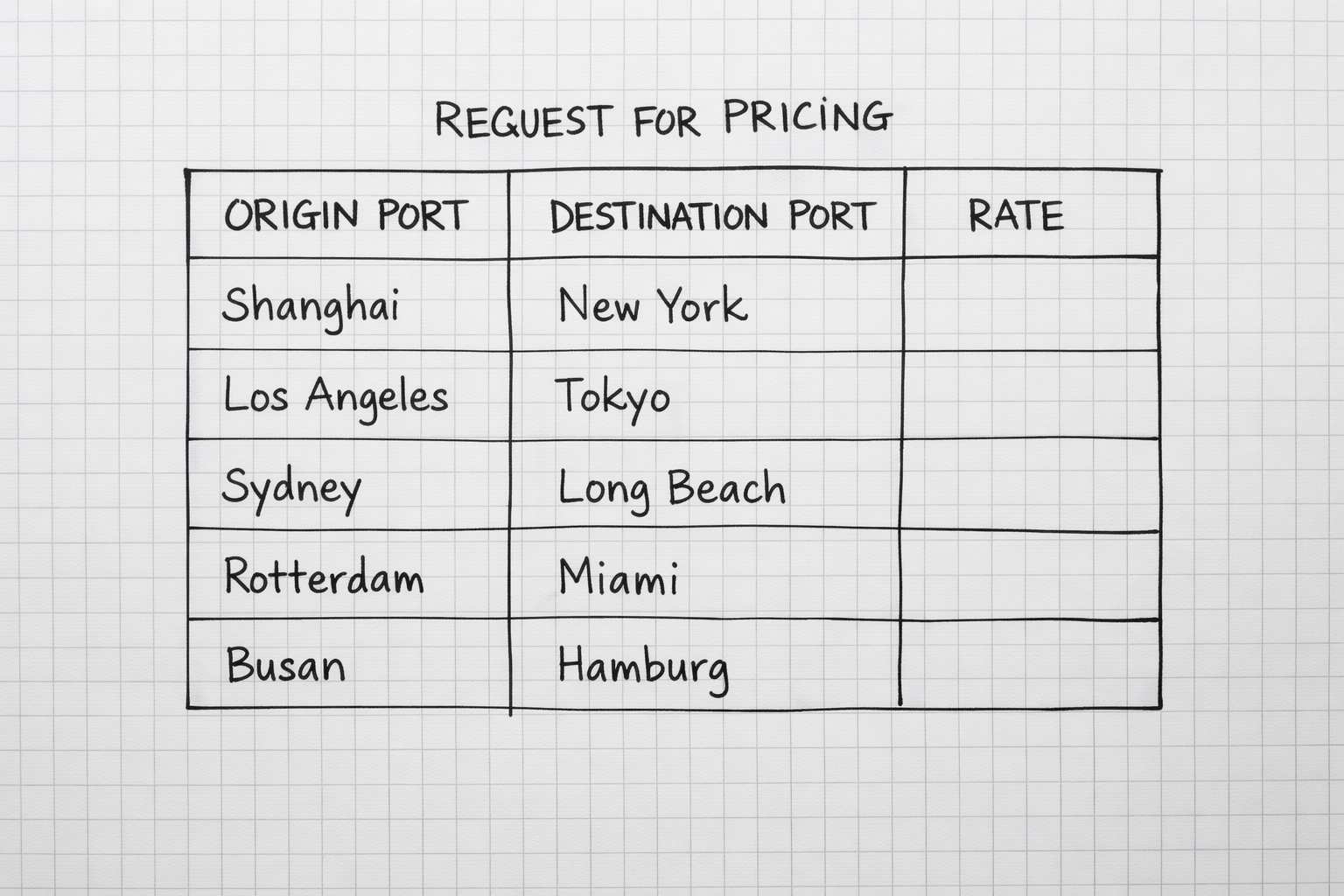
Why Annual Freight Rate Sheets Stop Reflecting the Market
Annual rate sheets create clarity at contract signing, but markets continue to evolve. Learn why static rate sheets create blind spots long before contracts expire.
Annual freight rate sheets solve one important problem.
They document the commercial agreement reached between shippers, carriers, and NVOCCs at the moment a contract is signed.
The challenge is that the market doesn't stop changing once those agreements are in place.
Capacity shifts. Service levels evolve. Surcharges change. Market conditions continue to evolve while the rate sheet remains exactly as it was on day one.
That doesn't make annual rate sheets obsolete.
It simply means they were never designed to answer a different question:
Do the assumptions behind this contract still reflect today's market?
Where Static Rate Sheets Quietly Fall Short
Annual rate sheets are built to do one thing well: document agreed terms at the moment a contract is signed.
-
They provide clarity.
-
They create accountability.
-
They make large, distributed organizations operable.
What they do not do, and were never designed to do, is reflect how those agreements perform as conditions change over time.
Once contracts are in force:
-
Capacity allocation shifts by lane and trade
-
Service reliability changes by carrier and sailing
-
Assessorial exposure evolves quietly
-
Priority changes during peak periods, even when base rates do not
For NVOCCs, buy-side commitments and sell-side expectations begin to diverge as markets move underneath static terms. None of this shows up on a rate sheet, but all of it affects outcomes.
Why This Feels Like the Same Movie Every Year
The issue is not that rates were wrong at negotiation. It is that once the contract is signed, the primary reference point stops evolving even though the market does not. So volatility does not show up as a signal.
It shows up later as:
-
Missed sailings
-
Rolled cargo
-
Budget variance
-
Strained internal and external conversations
By the time those issues surface, teams are already deep into execution and the question becomes how to manage the impact, not how to adjust the assumptions. That is why so many freight cycles feel familiar, even when the market is not. Not because nothing has changed, but because the way change is detected has not.
This Is Not About Doing Procurement Better
Static rate sheets are not a failure of procurement discipline. They are the product of a system designed for stability. What has changed is the environment.
Volatility is no longer episodic. It is persistent.
And when volatility persists, static reference points stop being sufficient. Not because they are wrong, but because they are incomplete.
What This Leads To
Once contracts are signed, procurement teams still need situational awareness.
Not to renegotiate constantly.
Not to undermine carrier relationships.
But to understand when market conditions are diverging from the assumptions those contracts were built on.
In more mature markets, that awareness comes from trusted benchmarks. These are continuously updated references that provide a pulse on how conditions are evolving over time.
Without that pulse, volatility does not disappear. It simply shows up somewhere else: in execution, in budgets, and in conversations that become harder to explain.
The goal isn't to replace annual contracts. It's to complement them with better market visibility throughout the life of the agreement.