
.jpg)
By: Gordon Downes, NYSHEX CEO and Co-Founder
Over the past two years, the number of ocean freight contracts that are index-linked has doubled annually, and today these types of agreements represent roughly 8% of contract volume on the major east-west trades. Two-thirds of the world’s leading ocean carriers now offer index-linked contracts, and many of the top global forwarders do as well.
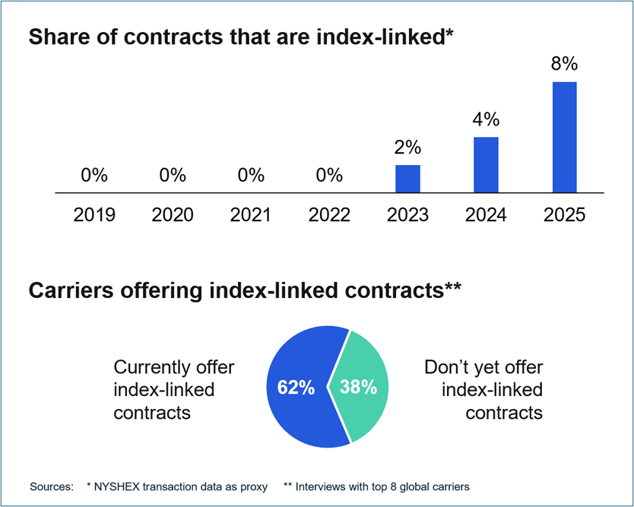
This rapid shift prompts 3 very important questions:
1. What Is Driving This Rapid Shift Toward Index-Linked Contracts?
Before 2023, index-linked agreements were rare. When they were used, it was primarily to recalibrate multi-year contracts to stay aligned with the “market,” reducing the time-consuming, relationship-straining annual RFP cycle.
Then in September 2022, as the world normalized post-COVID and supply chain bottle necks finally unclogged, spot rates collapsed:
- 2022 contract rates on Asia to USWC were set around $7,000/FEU
- 2022 spot rates also stayed around the $7,000 mark, until late August…
- Then by October that year, spot rates had fallen below $2,000
With the $5,000 delta between contract and spot rates, shippers began walking away from their contracts. In the scramble that followed, we saw the rapid shift from fixed rate contracts to floating or index-linked contracts pegged to weekly or monthly market indices such as the SCFI.
From this, the industry began to realize something important:
Index-linked contracts remove the need for constant renegotiation. They let prices adjust automatically with the market.
- Time saved.
- Sense of fairness.
- Relationships preserved.
This is the single biggest driver behind the shift toward index linked contracts.
2. How Do Shippers, Carriers, and Forwarders Manage Volatile Index Rates?
We all know spot rates are volatile. But most people don’t realize they are more volatile than equities, commodities, or even Bitcoin.
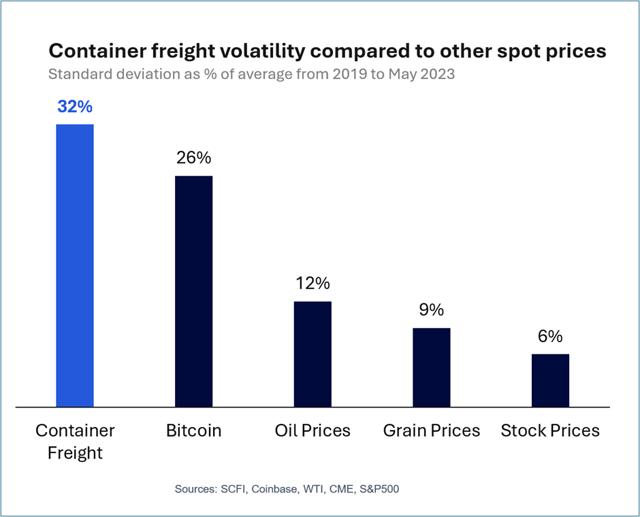
So how do CFOs create budgets or financial plans when the underlying freight rates can swing hundreds or thousands of dollars per container in weeks?
The truth is, even fixed rate contracts aren’t actually “fixed”. GRIs, PSSs, and priority loading fees which can be charged on top of fixed rate contracts mean that freight budgets have always been exposed to significant variations.
The difference with index-linked contracts is that we finally have the tools to manage freight volatility, just like how we manage many other financial risks.
Hedging index-linked contracts are now supported by leading banks, brokers, and exchanges, enabling shippers and carriers to benefit from:
- Forwards
- Swaps
- Options
- Futures
These instruments may sound complex, but many CFOs already use these same tools to hedge fuel, currency, interest rates and raw material costs.
Ocean freight is simply catching up — evolving into a more financially mature, risk-managed market.
3. Does It Matter Which Index You Link To?
Yes, it really matters.
Index-linked contracts only work if the index actually reflects the true spot market. If not, the entire structure breaks down.
When an index is built on quoted rates, it is inherently distorted:
- If a quoted rate is too high, no one books it — but it still pulls the index upward.
- If a quoted rate is too low, carriers won't load bookings it — but it still drags the index downward.
Because most quoted rates never result in a shipped container, quoted-rate indices mix in vast amounts of non-market data, diluting accuracy.
This leads to:
- Index rates that are above market → shippers divert volume
- Index rates that are below market → carriers divert capacity
- Relationship tensions
- Renegotiations
These are the exact issues index-linked contracts are supposed to resolve.
This is why the NYSHEX Freight Index (NYFI) is based solely on “shipped-on-board” rates — the prices buyers and sellers actually paid.
NYFI lags slightly behind some of the quoted or booked indices, such as SCFI. This is because it takes about three weeks from the time of booking for a container to be shipped-on-board a vessel. That’s ok, because accuracy matters more than speed. Afterall, the whole point of an index-linked contract is to stay aligned with the market, therefore the index must accurately reflect the market.
The Bottom Line
Index-linked contracts are here to stay. They are growing fast because they solve three fundamental problems:
- They eliminate the constant renegotiation cycle.
- They give shippers, carriers, and forwarders a proven way to manage volatility.
- They align behavior — but only when the index itself is accurate.
The foundation of this evolution is the index itself. If you link to the right index, then index-linked contracts become fair, reliable, and sustainable. If you link to the wrong index, then all the old problems come back.
If you want to know whether index-linked contracts are right for you, download our free contract simulator, or schedule a session with the NYSHEX team. We're always here to help.