
Hedging
Volatility is the risk. Hedging is how leaders manage it.
Freight volatility isn’t just a pricing issue. It’s a financial exposure that pulls teams away.
Hedging allows shippers, NVOCCs, and carriers to protect budgets, stabilize margins, and plan with confidence, whether you’re buying, reselling, or operating freight capacity.
Freight hedging isn’t about predicting the market. It’s about removing uncertainty from your results.
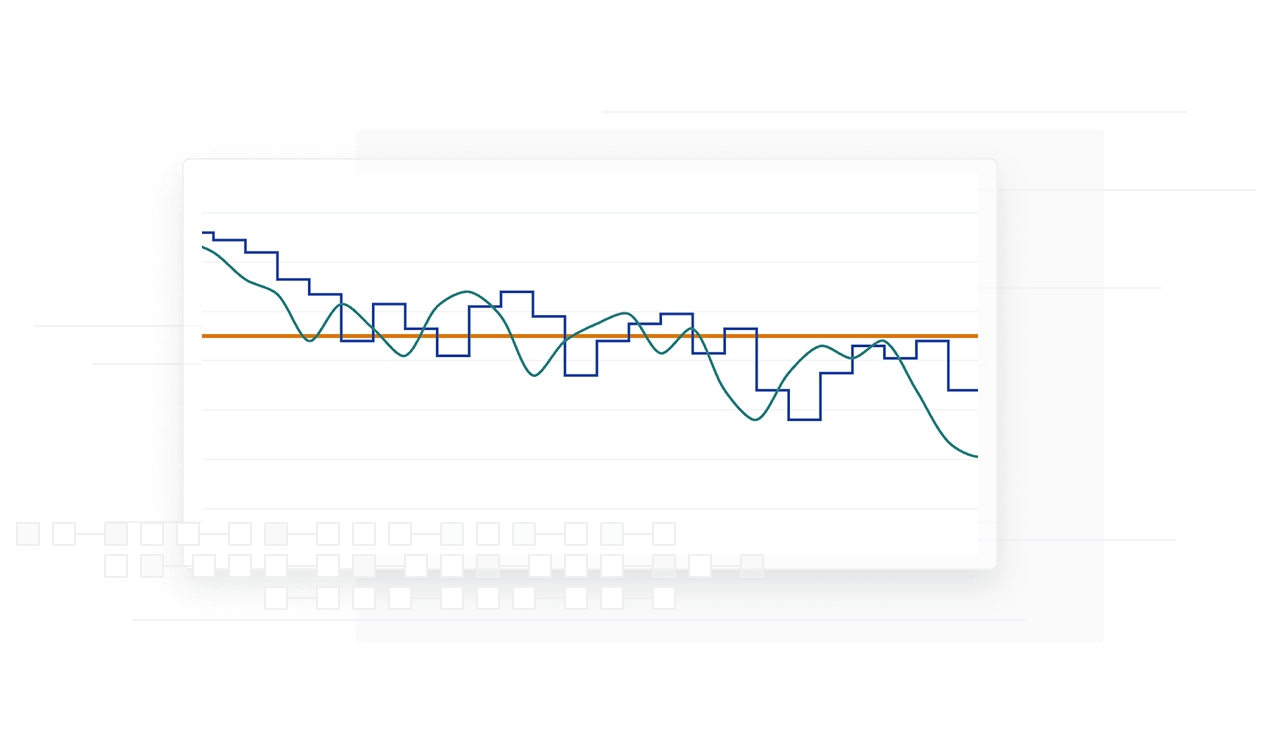
%201.png?width=1200&height=593&name=NYFI_Volatility_Hedging_Updated(1)%201.png)
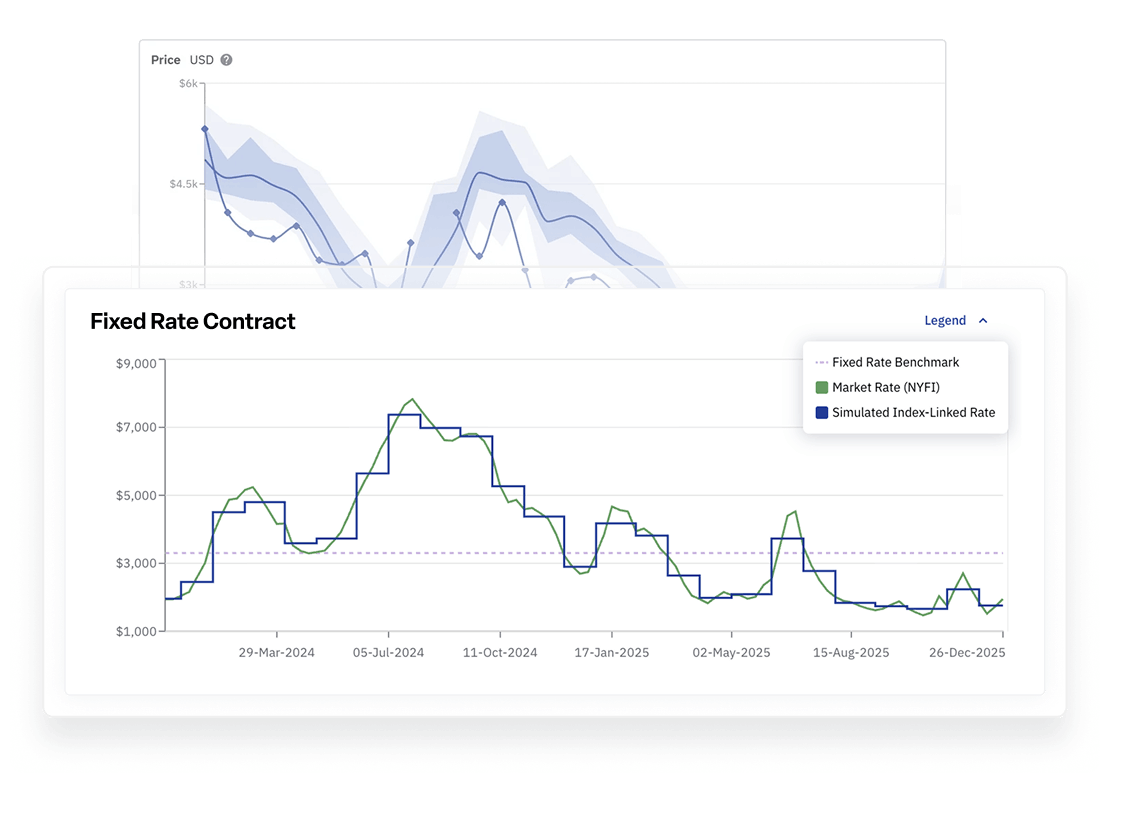
Why unmanaged volatility becomes a financial risk and why reacting isn’t a strategy.
Freight volatility isn’t just noise. It's financial exposure. When rates move sharply and unpredictably, the effects cascade across the business:
- Budget overruns and forecast misses
- Margin compression
- Emergency repricing decisions
- Reactive leadership conversations
- Missed planning windows
When volatility is unmanaged, every team ends up reacting instead of doing what they’re best at. For shippers, that means unstable budgets. For NVOCCs, it means margin exposure. For carriers, it means yield and network uncertainty.
Index-linked contracts align pricing with the market. Hedging goes one step further: it allows you to lock in outcomes even when the market moves.
That’s why leading industries hedge fuel, FX, and commodities. Freight is no different.
Start a Hedging Conversation
What is freight hedging?
Freight hedging is the use of financial instruments, such as futures and options, to offset exposure to freight rate movements.
It allows you to:
- Fix or cap your effective freight cost
- Protect against sharp upward moves
- Smooth results across volatile periods
- Separate operational execution from financial risk
It’s risk management and it allows commercial, operational, and finance teams to each focus on their role without being pulled into market volatility.
What Futures & Options Can I Trade?Benefits
Why hedge freight?
Whether you’re a shipper, NVOCC, or carrier, hedging offers strategic benefits.
Create certainty in a volatile environment
Hedging turns volatility into certainty.
In a market that moves unpredictably, hedging stabilizes financial outcomes so that costs, margins, and revenue reflect your plan, not the latest market swing.
Outcome: Replace uncertainty with control and protect your business from adverse price shocks.
Protect budgets without distracting your supply chain
When rates spike, hedges offset the impact.
When volatility rises, logistics teams stay focused on execution, not firefighting prices. Hedging decouples operational performance from financial exposure.
Outcome: Execute your supply chain with confidence while managing costs separately.
Control margin risk while expanding your commercial offering
Volatility creates opportunity if it’s managed.
Hedging allows NVOCCs to protect margins while structuring products that help customers manage their own exposure.
Outcome: Win more business with differentiated offerings without taking on unmanaged market risk.
Reduce friction without sacrificing commercial discipline
Volatile markets strain carrier–customer relationships, driving renegotiation, contract friction, and uncertainty on both sides.
Hedging separates price risk from the relationship itself.
Outcome: Fewer contract failures, more predictable volume, and stronger long-term partnerships.
How hedging works alongside index-linked contracts.
Index-linked contracts and hedging are complementary.
- Index-linked contracts keep pricing aligned with the real market
- Hedging allows you to manage where you ultimately land
Together, they create:
- Transparent pricing
- Aligned incentives
- Predictable financial outcomes
- Separation of commercial execution from price risk
This separation is what allows organizations to operate calmly, even as the market moves.
This is how mature markets operate.
Freight is catching up.
What Freight Futures Can I Trade?
Is Freight Hedging Right for You?
Freight hedging is typically used by organizations that:
- Have material freight exposure
- Need cost, margin, or revenue stability
- Operate across volatile lanes
- Are planning 6–36 months ahead
You don’t hedge everything. You hedge what matters.
So the rest of the organization can focus on execution, growth, and planning, not constant volatility management.
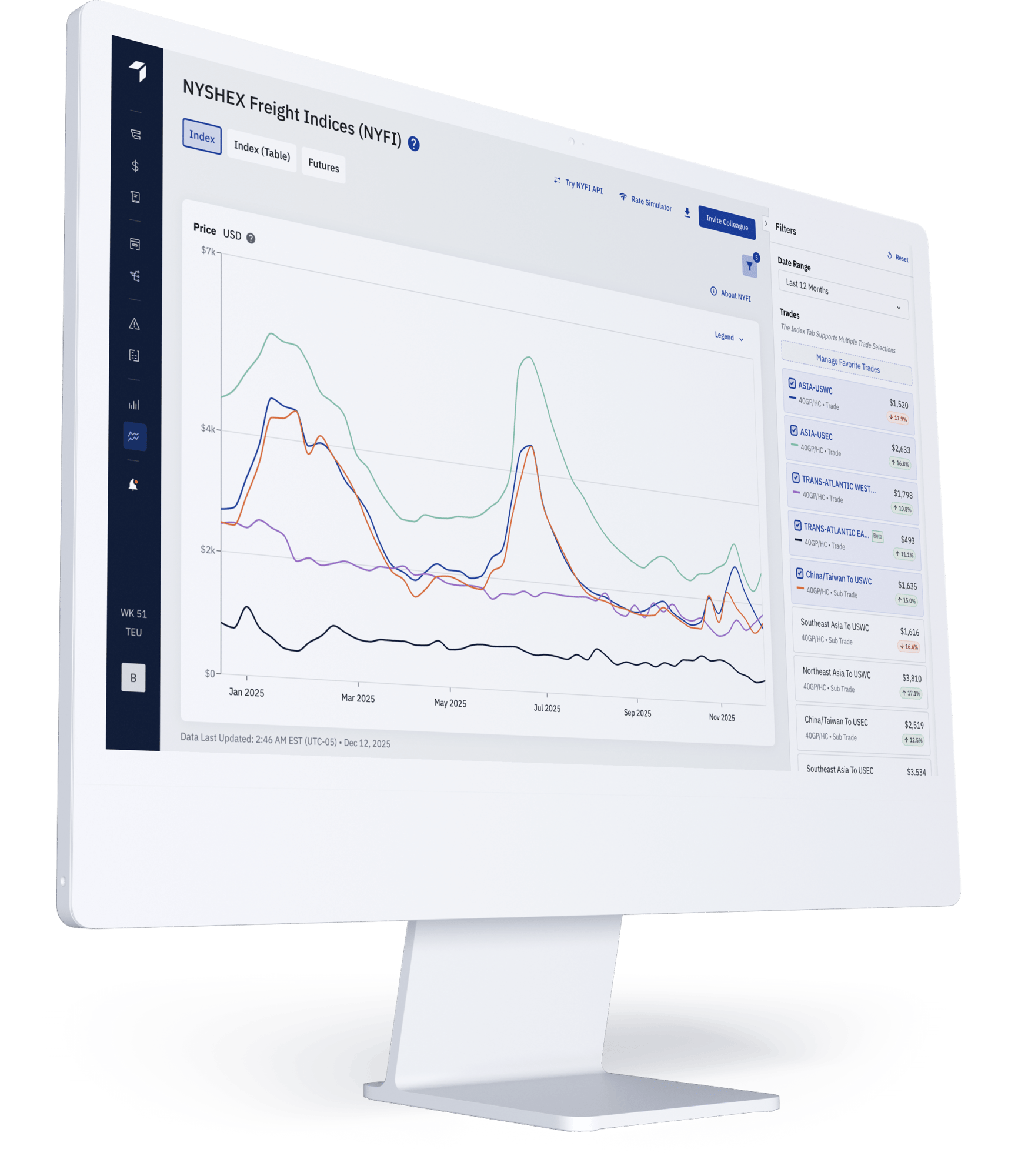
The index you choose matters. Especially for hedging.
Your hedge is only as strong as the benchmark beneath it.
A hedging instrument must settle against an index that is:
- Transparent — Methodology and surcharges are fully published
- Trusted — Free from bias or unilateral control
- Neutral — Governed across all sides of the market
- Rooted in real activity — Built on shipped data, not quotes or intentions
NYFI meets all four. It is the only index built on millions of invoiced, shipped transactions, governed equally by shippers, carriers, and NVOCCs, and published freely every week.
That's why NYFI is the foundation for freight hedging.
Sign Up for NYFI
How to get started with freight hedging.
Freight hedging and modern risk management don’t require turning your team into traders. They require the right foundation.
NYSHEX Academy is designed to help shippers, NVOCCs, and carriers understand index-linked contracts, hedging concepts, and the financial tools shaping the future of freight. Courses focus on practical decision-making, commercial strategy, and risk discipline so your teams can engage confidently, ask the right questions, and make informed choices.
Build the knowledge before you deploy the tools.